If you wake up exhausted, snore loudly, or grind your teeth at night, the problem may not be stress or poor sleep habits. It may be your airway. An airway dentist in Wilmington NC looks past the teeth and gums to examine the structures that control how you breathe while you sleep, and that assessment can change the course of your health in ways that go well beyond a good night’s rest.
What Airway Dentistry Actually Is
Airway dentistry is a branch of biological and holistic dental care focused on how the size and shape of your jaw, palate, tongue, and throat affect your breathing, especially during sleep. A dentist trained in airway evaluation understands that a narrow jaw or a tongue that rests too far back doesn’t just affect how your teeth fit together; it affects how much oxygen reaches your brain and body every single night.
This is different from simply fitting you for a mouthguard and sending you home. Airway-focused care starts with understanding the root cause of why your breathing is restricted in the first place.
Sleep-Disordered Breathing: More Than Just Snoring
Sleep-disordered breathing (SDB) is an umbrella term for conditions where airflow is partially or fully blocked during sleep. It ranges from simple snoring on one end to obstructive sleep apnea (OSA) on the other. OSA is defined by repeated pauses in breathing during sleep, each one forcing your body to partially wake up and restart the airflow.
According to the American Academy of Sleep Medicine, an estimated 30 million Americans have obstructive sleep apnea, and the majority remain undiagnosed. That gap matters because untreated SDB doesn’t stay contained to your sleep. It creates a cascade of systemic effects that show up in your cardiovascular health, blood sugar regulation, mental clarity, and immune function.
Why a Dentist Is Often the First to Spot It
Your dentist sees your mouth in a way no other provider does. During a routine exam, an airway-aware dentist can observe signs that suggest restricted breathing long before you’ve been formally diagnosed:
- A high, narrow palate (the roof of your mouth) that leaves little room for the tongue
- A small or recessed lower jaw that crowds the airway from the front
- Scalloping along the edges of the tongue, which indicates the tongue is pressing against the teeth for space
- Worn-down or flattened teeth from nighttime grinding (called bruxism), which is often the body’s reflex to reposition the jaw and reopen the airway
- Enlarged tonsils or a uvula (the tissue that hangs at the back of the throat) that narrows the throat during sleep
- A forward head posture that compresses the airway at the neck
None of these signs alone confirms sleep apnea, but they tell a trained clinician that the anatomy warrants a closer look.
How an Airway Dentist in Wilmington NC Evaluates Your Breathing
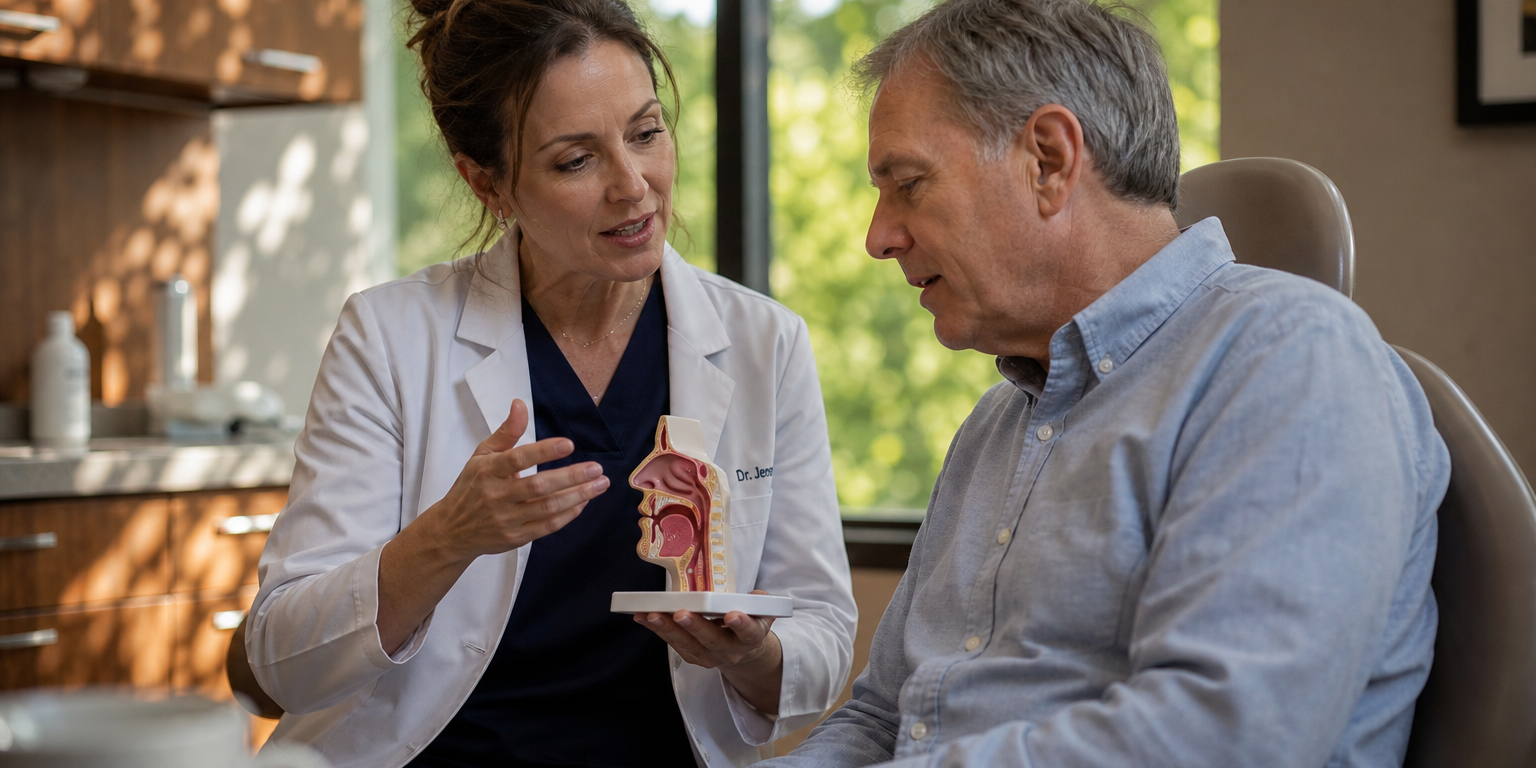
An airway dentist in Wilmington NC uses a combination of clinical observation, patient history, and diagnostic imaging to build a complete picture of what’s happening when you sleep.
The Clinical Exam
The first step is a thorough oral and facial examination. Your dentist will assess:
- The width and height of your palate
- The position and size of your tongue at rest
- Your jaw alignment and how far your lower jaw sits in relation to your upper
- The Mallampati score, a simple visual scale that rates how visible the throat structures are when you open wide; a higher score correlates with a higher risk of airway obstruction
- The tonsils and soft tissue at the back of the throat
Your sleep history matters here too. Questions about daytime fatigue, waking with headaches, dry mouth in the morning, and whether a partner has noticed you stop breathing or gasp are all part of the picture.
Imaging and Technology
A full airway assessment often includes a cone beam CT scan (also called CBCT), a low-radiation, three-dimensional X-ray that lets your dentist measure the actual volume of your airway at multiple points. This imaging reveals narrowing that a visual exam alone would miss.
Some practices also use acoustic pharyngometry, a sound-based measurement tool that maps the shape and size of your airway in seconds without any radiation at all.
At Wilmington Holistic Dentistry, the goal of this evaluation phase is not to diagnose sleep apnea (that requires a formal sleep study ordered by a physician) but to identify anatomical risk factors and coordinate care with the right medical partners.
Sleep Studies and Collaborative Care
If clinical and imaging findings suggest significant airway compromise, your dentist will refer you for a sleep study, either a polysomnography (an in-lab overnight study) or a home sleep test. These studies measure oxygen levels, breathing effort, heart rate, and the number of times per hour your airway closes during sleep.
A result is typically expressed as the apnea-hypopnea index (AHI): the number of breathing interruptions per hour. Mild sleep apnea is 5 to 14 events per hour; moderate is 15 to 29; severe is 30 or more. The American Academy of Sleep Medicine provides clinical guidelines for how each level is managed.
An airway dentist works alongside your physician and sleep specialist. This isn’t a situation where one provider replaces another; it’s a genuinely collaborative model.
The Systemic Consequences of Untreated Sleep-Disordered Breathing
Untreated sleep-disordered breathing carries documented health consequences that extend well beyond fatigue. Research published through the National Institutes of Health links OSA to a significantly elevated risk of hypertension, with some studies placing that risk at two to three times higher than in people without SDB. OSA is also independently associated with increased risk of atrial fibrillation, type 2 diabetes, metabolic syndrome, and depression.
For children, the consequences show up differently. Restricted nighttime breathing in kids is strongly linked to behavioral issues that mimic ADHD, poor academic performance, bed-wetting, and facial development problems. The jaws and palate develop rapidly in childhood, and a child who breathes primarily through the mouth (often because the nasal airway is blocked) develops a narrower, higher palate over time. That structural change makes the airway problem worse as the child grows.
The Gut-Brain-Airway Connection
From a whole-health perspective, chronic sleep disruption affects virtually every system in the body. Cortisol (the primary stress hormone) rises when sleep is fragmented. Elevated cortisol suppresses immune function, promotes inflammation, disrupts blood sugar balance, and impairs tissue repair. The mouth, as the entry point to both the digestive and respiratory systems, sits at the center of this web.
A biological dentist understands this connection. Treating a narrow airway isn’t just about snoring; it’s about reducing the physiological burden that disrupted sleep places on the body night after night.
How Airway-Focused Dentistry Treats Sleep-Disordered Breathing
Treatment depends entirely on what the evaluation finds. There is no one-size approach; the right intervention follows the anatomy and the severity.
Oral Appliance Therapy
Mandibular advancement devices (MADs) are custom-fitted oral appliances that gently reposition the lower jaw forward during sleep. Moving the jaw forward pulls the tongue and soft tissues away from the back of the throat, enlarging the airway. The American Academy of Dental Sleep Medicine recognizes oral appliance therapy as a first-line treatment for mild to moderate OSA and as an alternative for patients with severe OSA who can’t tolerate CPAP.
A custom appliance from a trained airway dentist is not the same as an over-the-counter mouthguard from a pharmacy. It’s designed to your specific anatomy, adjustable over time, and monitored for changes in bite and jaw joint comfort.
Myofunctional Therapy
Orofacial myofunctional therapy (OMT) addresses the muscle patterns that contribute to airway restriction. A myofunctional therapist, often working in coordination with your airway dentist, uses targeted exercises to retrain the tongue to rest on the roof of the mouth, encourage nasal breathing, and strengthen the muscles of the throat and face.
A 2015 systematic review published in SLEEP found that myofunctional therapy reduced AHI by approximately 50% in adults and by nearly 62% in children. These are meaningful reductions, particularly for patients with mild to moderate severity.
Palatal Expansion
For patients with a high, narrow palate, expanding the palate widens both the dental arch and the nasal cavity above it. A wider nasal cavity means better nasal airflow, which is the body’s preferred breathing route. In children, this is accomplished with removable or fixed expanders during the years when the palate’s growth suture is still flexible. In adults, a newer technique called MARPE (miniscrew-assisted rapid palatal expansion) makes expansion possible even after the suture has fused.
CPAP Coordination
For patients with severe OSA, CPAP (continuous positive airway pressure) therapy is typically the most effective treatment. A CPAP machine delivers a constant stream of pressurized air through a mask to keep the airway open. Some patients tolerate it well; others find it difficult to use consistently.
An airway dentist can work alongside your sleep physician to explore combination approaches: an oral appliance that reduces CPAP pressure requirements, or jaw repositioning that makes the mask fit more comfortably. The goal is always effective, sustainable treatment.
Why Holistic and Biological Dentists Take Airway Seriously
A biological dentist sees the mouth as part of the whole body, not a separate system to be managed in isolation. The materials used in airway appliances, like any dental device, are evaluated for biocompatibility (how well a material is tolerated by the specific patient’s body). If you’re already managing sensitivities to metals or synthetic materials, this matters.
Beyond materials, the whole-health framing shapes how treatment is prioritized. If a patient comes in for teeth grinding and the real driver is an obstructed airway, addressing the surface symptom without the underlying cause isn’t good care. That perspective is foundational to how biological dentists approach patient care.
Signs You Should Ask Your Dentist About Your Airway
You don’t need a formal sleep apnea diagnosis to bring this up at your next appointment. Any of the following is worth mentioning:
- You wake up feeling unrefreshed, even after a full night of sleep
- You snore regularly, or a partner has mentioned pauses in your breathing
- You grind or clench your teeth and your dentist has pointed it out
- You wake up with a dry mouth, headache, or sore jaw
- You feel chronically fatigued or foggy during the day
- You have a child who snores, breathes through the mouth, or has been evaluated for ADHD
- You’ve tried a CPAP and couldn’t stay consistent with it
For more context on what to look for in a provider before you schedule, our post on what to know before choosing an airway dentist walks through the key questions in plain language.
Frequently Asked Questions
What does an airway dentist in Wilmington NC actually do?
An airway dentist in Wilmington NC evaluates the anatomy of your jaw, palate, tongue, and throat to identify structural factors that may be restricting your breathing during sleep. Using clinical exams, patient history, and imaging like cone beam CT scans, they identify signs of sleep-disordered breathing and coordinate treatment, which may include custom oral appliances, myofunctional therapy, palatal expansion, or referral for a sleep study. The goal is to address the root cause of restricted airflow, not just the symptoms.
Is an oral appliance from a dentist better than a CPAP machine?
For mild to moderate obstructive sleep apnea, oral appliance therapy is recognized as a first-line treatment and works well for many patients, particularly those who find CPAP difficult to tolerate. For severe sleep apnea, CPAP typically delivers more complete airway support. Many patients with severe OSA work with both a sleep physician and an airway dentist to use a combination approach: an oral appliance that improves CPAP comfort or reduces the pressure needed. The right answer depends on your specific AHI and anatomy.
Can a dentist diagnose sleep apnea?
A dentist cannot formally diagnose sleep apnea; that requires a sleep study interpreted by a qualified physician or sleep specialist. What an airway-trained dentist can do is identify the anatomical risk factors that suggest a problem, screen for symptoms, and refer you to the appropriate provider for a formal diagnosis. Dentists and sleep physicians work best as a team, not in place of each other.
How do I know if my child’s breathing problem is an airway issue?
Children with airway restriction often don’t complain about sleep; their symptoms look different. Watch for mouth breathing during the day or night, snoring, restless sleep, bed-wetting past the expected age, or behavioral and attention issues that seem out of proportion. Narrow dental arches and crowded teeth in a growing child can also be a structural signal. Early evaluation by an airway-aware dentist and, if needed, a pediatric ENT (ear, nose, and throat specialist) gives children the best opportunity to develop normally.
Does teeth grinding always mean there’s an airway problem?
Not always, but the connection is well-established and worth investigating. Bruxism (grinding and clenching) is often the body’s reflexive attempt to advance the lower jaw and reopen a narrowing airway during sleep. If your dentist notices significant wear on your teeth and you also wake up tired, have a dry mouth, or snore, an airway evaluation makes sense as a next step rather than simply fitting a night guard to protect the teeth.
What makes airway dentistry different from what a conventional dentist does?
Most conventional dental exams focus on the teeth, gums, and existing restorations. An airway-trained dentist adds a systematic evaluation of the soft tissue, jaw position, palate width, tongue posture, and throat space, and connects those findings to your sleep quality and overall health. The difference is in scope: one looks at what’s in the mouth, the other looks at how the mouth functions as part of your respiratory and whole-body health picture.
Wondering if an airway evaluation is the right next step for you?
If you’re waking up tired, dealing with chronic grinding, or just have a feeling that your sleep isn’t doing what sleep is supposed to do, a conversation with an airway-trained dentist is a low-pressure place to start. At Wilmington Holistic Dentistry, we approach airway concerns the same way we approach everything else: as part of your whole-body health, not an isolated dental problem.
Schedule a consultation at Wilmington Holistic Dentistry or call us at (910) 777-4020.