
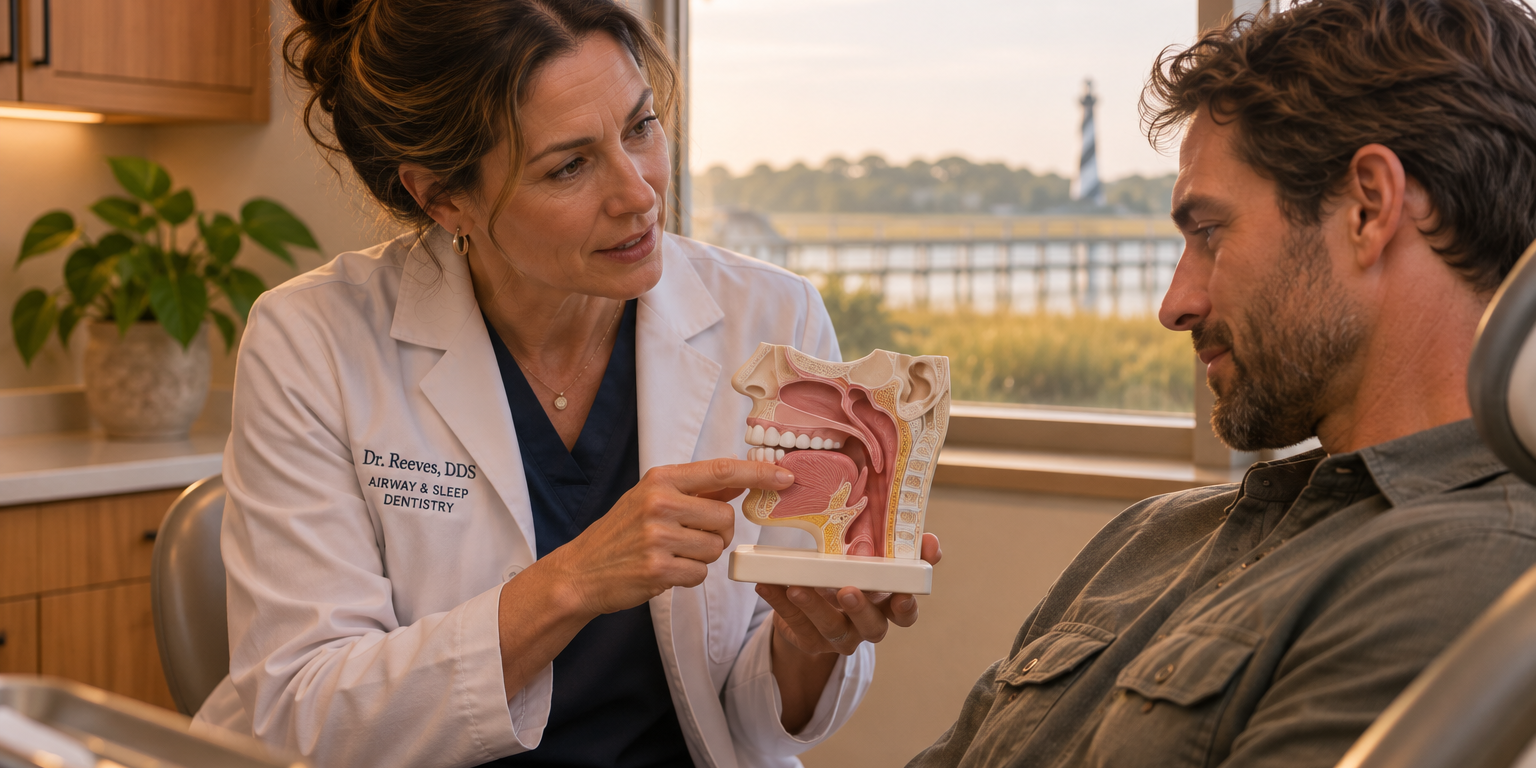
If you snore, wake up tired no matter how long you sleep, or grind your teeth at night, the problem might not be your sleep habits. It might be your airway. Airway dentistry is a branch of holistic dental care that looks at how the size and shape of your jaw, the position of your tongue, and the structure of your palate affect how well you breathe, especially while you sleep. This guide covers what airway dentistry is, the signs that you might benefit from it, and what to expect when you see an airway-focused dentist.
What Airway Dentistry Actually Is
Airway dentistry treats the mouth and jaw as part of the breathing system, not just as the place where teeth live. When the jaw is underdeveloped, the palate is too narrow, or the tongue doesn’t have enough room to rest properly, the airway can become restricted. That restriction makes it harder for air to move freely while you sleep, which can range from mild snoring to a more serious condition called obstructive sleep apnea (OSA), where breathing actually stops and starts throughout the night.
The American Academy of Sleep Medicine estimates that roughly 26% of adults between 30 and 70 have some form of sleep apnea, and many don’t know it. Airway dentistry addresses those structural causes rather than just managing symptoms with a CPAP machine, though CPAP remains a valid tool for many patients.
A holistic approach to airway dentistry goes a step further. It considers how jaw development, oral posture, tongue function, and even breathing habits during the day all connect to sleep quality, energy levels, and overall health.
How the Jaw and Palate Affect Breathing
Your upper palate (the roof of your mouth) is also the floor of your nasal passage. A palate that’s high and narrow leaves less room for nasal airflow, which pushes people to breathe through their mouths. Mouth breathing bypasses the nose’s natural filtering and humidifying system, and over time it can reinforce the same narrow jaw structure that caused the problem.
In children, these patterns show up early. Mouth breathing, frequent ear infections, bedwetting, crowded teeth, and poor attention at school have all been linked to airway problems. Catching them young means the jaw is still growing and can often be guided into a healthier shape without surgery.
The Connection to Whole-Body Health
Poor sleep quality from restricted breathing doesn’t just leave you tired. Research published in journals like Sleep has connected untreated sleep-disordered breathing to higher risks of high blood pressure, blood sugar dysregulation, and cardiovascular strain. That’s the oral-systemic connection that holistic dentists take seriously: what happens in your mouth doesn’t stay in your mouth.
Signs You Might Need Airway Dentistry
Airway dentistry is worth exploring if several of the following sound familiar to you.
- Snoring, or a partner who tells you that you stop breathing at night
- Waking up with a dry mouth, sore throat, or headache
- Feeling unrefreshed after a full night of sleep
- Teeth grinding or clenching (called bruxism), especially at night
- A scalloped edge along the sides of your tongue (a sign the tongue is pressing against the teeth, often because it has nowhere else to go)
- Crowded or narrow teeth, even after orthodontic treatment
- Chronic jaw tension or TMJ discomfort (the temporomandibular joint connects your jaw to your skull)
- Difficulty breathing through your nose
- In children: mouth breathing, bedwetting past age five, difficulty focusing, or behavioral changes
None of these symptoms alone proves an airway problem exists. But a dentist trained in airway evaluation can connect the dots in a way that a standard dental visit often doesn’t.
What an Airway Dentistry Appointment Looks Like
An airway-focused dental visit covers more ground than a typical checkup. Here’s what you can generally expect.
A Detailed Health History
Your dentist will ask about your sleep, your energy levels, whether you snore, and whether you’ve ever been evaluated for sleep apnea. Some practices also ask about childhood breathing patterns, since those early habits leave structural clues.
An Oral Structural Exam
Your dentist will look at the size of your airway opening, the position and size of your tonsils and tongue, the shape of your palate, your bite, and how your teeth come together. They may also evaluate your tongue’s resting posture, which is called myofunctional assessment. A tongue that sits low or pushes forward against the teeth is a common finding in patients with airway concerns.
Imaging
Many airway dentists use a type of 3D imaging called a cone beam CT (CBCT) scan. This gives a detailed, three-dimensional picture of the airway, jaw joints, and surrounding bone that a standard two-dimensional X-ray simply can’t show. Some practices also use acoustic pharyngometry, a device that measures the actual dimensions of the airway using sound waves.
A Collaborative Care Plan
Airway dentistry works best as a team effort. Depending on what’s found, your dentist may coordinate with a sleep medicine physician for a formal sleep study, an ear-nose-throat specialist, an orthodontist trained in airway expansion, or a myofunctional therapist who works on tongue and facial muscle patterns. The dental work and the other therapies reinforce each other.
Treatments an Airway Dentist May Offer
Treatment depends entirely on what’s driving the problem. Common approaches include the following.
Oral appliance therapy: A custom-fitted device worn at night that gently repositions the lower jaw forward, keeping the airway open. For patients with mild to moderate sleep apnea, the American Academy of Dental Sleep Medicine recognizes oral appliances as a first-line treatment alternative to CPAP.
Palatal expansion: Devices that gradually widen the upper jaw, creating more room for the tongue and improving nasal airflow. This works most effectively in children and adolescents whose palates are still forming, but adult versions exist too.
Myofunctional therapy: Targeted exercises for the tongue, lips, and facial muscles that retrain breathing and swallowing patterns. Think of it as physical therapy for the muscles that support your airway.
Frenectomy: A simple procedure to release a tongue-tie (a short or tight band of tissue under the tongue, called a lingual frenum) that restricts tongue movement and prevents proper tongue posture.
Referral for a sleep study: If sleep apnea is suspected, a home sleep test or an in-lab polysomnography study gives the full picture before any treatment decisions are made.
How Airway Dentistry Fits a Holistic Philosophy
Conventional dentistry focuses on teeth and gums. Airway dentistry asks a bigger question: is this person’s whole body getting the rest and oxygen it needs? That framing fits naturally within a holistic practice, where the goal is never to treat a tooth in isolation.
At Wilmington Holistic Dentistry, airway evaluation sits alongside biocompatible materials, ozone therapy, and mercury-safe protocols as part of a whole-person approach to dental health. If you’ve read about how holistic dentistry in Wilmington, NC works, airway care is a natural extension of that same philosophy: your body is a connected system, and your dentist should treat it that way.
How to Find an Airway Dentist Near You
Airway dentistry is a specialty area, and not every dental practice offers it. When you’re searching for an airway dentist near you, look for a few things specifically.
- Training in dental sleep medicine or airway-focused care. Look for dentists who have completed continuing education through organizations like the AADSM or the IAOMT, or who list airway dentistry as a named service, not just a passing mention.
- Access to 3D imaging. A practice without cone beam CT capability is working with limited information on structural airway problems.
- A collaborative model. A good airway dentist doesn’t work alone. Ask whether they coordinate with sleep physicians and other specialists.
- A whole-health intake. If a practice asks only about your teeth and gums and never asks how you sleep or breathe, they’re probably not focused on airway issues.
- Willingness to listen. Symptoms like fatigue and jaw tension are easy to dismiss. An airway-focused dentist takes the full picture seriously.
For a deeper look at what to ask before you choose a provider, this guide to finding an airway dentist near Wilmington walks through the key questions.
Frequently Asked Questions
What is airway dentistry and how is it different from regular dentistry?
Airway dentistry evaluates how the jaw, palate, and oral structures affect breathing and sleep, while conventional dentistry focuses primarily on teeth and gums. An airway dentist looks for structural causes of snoring, sleep apnea, teeth grinding, and poor sleep quality, then treats those root causes rather than just the downstream symptoms.
Can a dentist actually help with sleep apnea?
Yes, for mild to moderate obstructive sleep apnea, a dentist trained in dental sleep medicine can fit a custom oral appliance that keeps the airway open during sleep. The American Academy of Dental Sleep Medicine recognizes this as a clinically validated treatment. For severe sleep apnea, oral appliances are often used alongside other therapies, and coordination with a sleep physician is standard.
How do I know if my child needs airway dentistry?
Signs in children include chronic mouth breathing, snoring, restless sleep, bedwetting past age five, crowded teeth, frequent ear or throat infections, and difficulty focusing in school. These patterns can point to an airway problem that, if caught early while the jaw is still developing, may be correctable with expansion devices and myofunctional therapy rather than surgery.
Is airway dentistry covered by insurance?
Coverage varies. Oral appliances for diagnosed sleep apnea are often covered under medical insurance rather than dental insurance, especially when a physician’s diagnosis and a sleep study are part of the record. Palate expansion may be covered under orthodontic benefits. It’s worth calling your insurer before your appointment and asking specifically about coverage for dental sleep medicine devices.
What is the difference between a tongue-tie and an airway problem?
A tongue-tie (restricted lingual frenum) is one structural factor that can contribute to an airway problem, but they’re not the same thing. A tight frenum prevents the tongue from resting properly on the roof of the mouth, which can lead to low tongue posture, mouth breathing, and eventual narrowing of the palate. Releasing the frenum through a frenectomy is often one part of a broader airway treatment plan that may also include myofunctional therapy and palate expansion.
Does airway dentistry require surgery?
Most airway dentistry is non-surgical. Oral appliances, palate expanders, myofunctional therapy, and frenectomy (a minor soft-tissue procedure) are the most common tools. Surgery is generally reserved for cases where structural problems in the nose, throat, or jaw are severe enough that conservative approaches won’t resolve them, and those referrals go to ENT specialists or oral surgeons.
Curious whether airway dentistry could address your sleep or breathing concerns?
At Wilmington Holistic Dentistry, we approach airway evaluation as part of whole-person care, connecting what’s happening in your mouth to how well you feel during the day. Schedule a consultation to talk through your symptoms, or call us at (910) 777-4020 to ask whether an airway evaluation makes sense for you.