
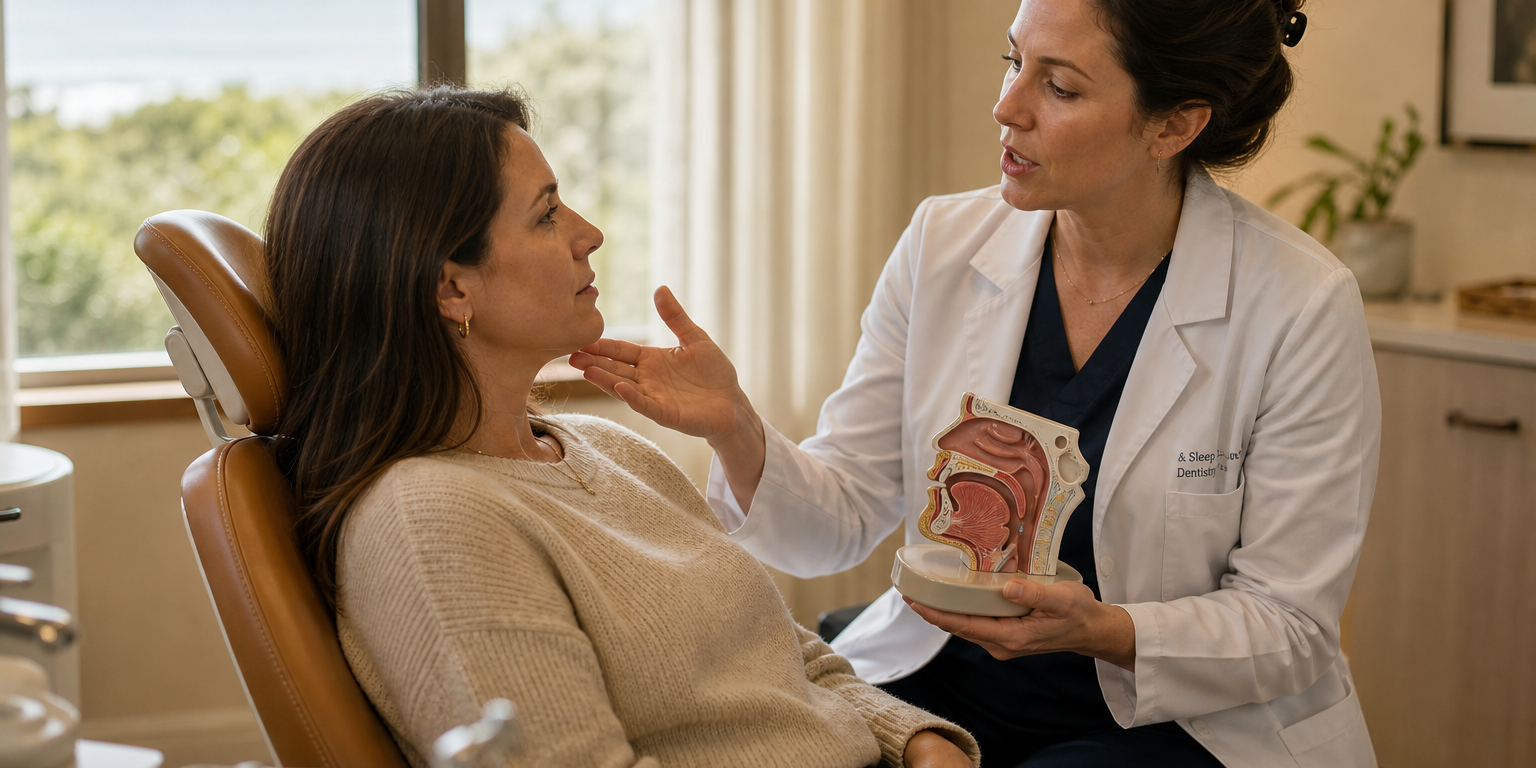
Searching for an airway dentist near me and not sure what that phrase actually means? Airway dentistry focuses on how the structure of your mouth, jaw, and throat affects your breathing, especially during sleep. It’s a field that overlaps with sleep medicine and orthodontics, but a trained airway dentist brings a specific set of tools and a whole-body perspective that makes the approach different from any one of those alone.
What an Airway Dentist Near Me Actually Does
An airway dentist evaluates the relationship between your oral anatomy and your breathing. That means looking at jaw position, tongue posture, palate width, and airway size, not just teeth and gums. The goal is to find physical reasons why breathing becomes restricted, particularly at night, and to address those causes rather than just manage the symptoms.
This is different from what a conventional dentist does at a routine cleaning, and it’s different from what a sleep specialist does in a lab. Each has a role. The airway dentist connects the structural picture (what your mouth looks like) to the functional one (how well you actually breathe).
Why Breathing and Oral Structure Are Connected
Your airway runs directly through and behind your mouth. The size of your palate, the position of your lower jaw, and even the resting position of your tongue all shape how much space air has to pass through. Research published through the American Academy of Sleep Medicine links narrow palates and retrognathic jaws (jaws positioned too far back) to higher rates of obstructive sleep apnea.
When those structures are too small or misaligned, the soft tissue of the throat can collapse inward during sleep. The result might be snoring, restless sleep, waking with headaches, or a formal diagnosis of obstructive sleep apnea (OSA), which means breathing repeatedly stops and restarts during sleep.
Signs That Suggest an Airway Issue
Not everyone with an airway concern knows they have one. Some common signs that patients bring up in the chair include:
- Snoring that a partner has mentioned
- Waking unrefreshed despite a full night’s sleep
- Grinding or clenching teeth at night
- Chronic morning headaches or jaw soreness
- Mouth breathing during the day or at night
- Children who are restless sleepers, bedwetters, or show attention difficulties
That last point matters. Airway problems in children are often mistaken for behavioral issues. The American Academy of Pediatrics has noted connections between sleep-disordered breathing and attention and behavioral symptoms in children. Identifying the structural cause early can change the trajectory for a child’s development.
How Airway Dentistry Differs From Sleep Medicine and Orthodontics
This is the question patients ask most often, and the confusion is understandable. Here’s how the roles break down:
A sleep specialist (typically a pulmonologist or neurologist) diagnoses sleep disorders using overnight sleep studies. They can confirm whether you have sleep apnea and rate its severity. They often prescribe CPAP machines (continuous positive airway pressure devices that keep the airway open with pressurized air). What they generally don’t do is treat the structural cause inside the mouth.
An orthodontist moves teeth and, in some cases, expands the palate. Traditional orthodontic goals center on alignment and aesthetics. A growing number of orthodontists incorporate airway thinking into their work, but the primary training is still tooth and bite-focused.
An airway dentist sits at the intersection. They can fabricate oral appliances (custom mouthpieces that reposition the jaw during sleep), evaluate palate development, coordinate with sleep physicians, and in a holistic practice, look at the whole-body context: posture, tongue tie, diet, stress, and more.
The Holistic Angle: Why It Matters Here
A holistic or biological airway dentist doesn’t just ask “how do we open the airway?” They ask why it closed in the first place. That might mean looking at tongue tie (restricted movement of the tongue from a tight frenulum, the tissue connecting tongue to floor of mouth), mouth breathing habits that have reshaped the palate over years, or structural patterns that started in childhood.
At a practice like Wilmington Holistic Dentistry, that whole-body framing shapes how airway concerns get evaluated. The materials used, the approach to treatment, and the way findings connect to overall health are all part of the conversation. You can read more about that philosophy in the post on Airway Dentistry in Wilmington, NC: Sleep Better Naturally.
What to Look For When Searching for an Airway Dentist Near Me
Not every dentist who mentions sleep or breathing has formal airway training. Here are specific things worth asking about when you’re evaluating a provider:
- Training and credentials. Look for continuing education through organizations like the American Academy of Dental Sleep Medicine (AADSM) or the American Academy of Craniofacial Pain. These organizations set standards for airway-focused dental care.
- Diagnostic tools. A thorough airway evaluation should include more than a visual exam. Ask whether the provider uses cone-beam CT imaging (a 3D scan of the jaw and airway), airway analysis software, or sleep screening questionnaires to get a full picture.
- Collaboration with medical providers. Airway dentistry doesn’t replace a sleep study; it works alongside one. A good airway dentist will refer you for a sleep test if one is warranted and will communicate with your physician or sleep specialist.
- Experience with oral appliance therapy. Custom mandibular advancement devices (appliances that hold the lower jaw forward to keep the airway open) require careful fitting and follow-up. Ask how many the provider has placed and how they handle adjustments.
- Pediatric airway awareness. If you’re seeking care for a child, ask specifically whether the provider screens for tongue tie, mouth breathing, and palate development. These are different skill sets than adult airway care.
- Whole-body context. Does the provider ask about your sleep quality, energy, posture, and overall health, or only about your teeth? A practitioner who treats the mouth in isolation will miss connections that matter.
Questions to Ask at a First Visit
Before you commit to a provider, consider asking:
- “What does an airway evaluation look like in your practice?”
- “Do you work with sleep physicians or ENTs?”
- “What treatment options do you offer beyond oral appliances?”
- “How do you approach airway concerns in children?”
- “Are the materials you use biocompatible?” (This matters in a holistic practice setting.)
The answers will tell you quickly whether a provider is thinking about your whole health or just the narrow question of whether you snore.
What Airway Treatment Can Look Like
Depending on what an evaluation finds, treatment options in airway dentistry might include:
- Custom oral appliances that reposition the lower jaw during sleep
- Palate expansion (using a removable or fixed appliance to widen a narrow palate, making more room for the tongue and airway)
- Myofunctional therapy (exercises that retrain tongue posture and breathing patterns, often done with a separate therapist the dentist refers to)
- Frenectomy (releasing a tongue tie, often a minor soft-tissue procedure that can dramatically change tongue function)
- Coordination with CPAP therapy for patients with moderate to severe apnea who need both medical and dental support
Not every patient needs every option. A careful evaluation narrows the picture considerably. According to the American Academy of Sleep Medicine, oral appliance therapy is recommended for patients with mild to moderate OSA who prefer it over CPAP, and for those who can’t tolerate CPAP. That makes the airway dentist a clinically recognized part of the treatment picture, not an alternative route.
For a closer look at what to expect from a provider in this region specifically, the post Finding an Airway Dentist Near Wilmington: What to Look For covers local considerations in more depth.
Frequently Asked Questions
Is an airway dentist the same as a sleep dentist?
The terms overlap but aren’t identical. Sleep dentists typically focus on oral appliance therapy for diagnosed sleep apnea. Airway dentists take a broader view: they look at the structural causes of breathing problems, including palate size, jaw position, and tongue function, and may treat children and adults before a formal sleep apnea diagnosis is ever made. Many airway dentists also provide sleep appliances, so there’s significant overlap in practice.
Do I need a sleep study before seeing an airway dentist?
Not necessarily before your first visit, but a sleep study is often part of the process. An airway dentist can screen for signs of disordered breathing and help you decide whether a formal sleep study is warranted. If moderate or severe apnea is suspected, a sleep test is important before starting treatment, because the severity of the condition guides which treatment is safest and most effective.
Can airway dentistry help my child without braces or surgery?
In many cases, yes. Early palate expansion and myofunctional therapy can improve airway size and breathing patterns in growing children without surgery. The earlier a structural issue is identified, the more options exist, because a child’s palate is still developing and more responsive to gentle guidance. That said, some cases do require coordination with an orthodontist or oral surgeon, and a thorough evaluation will clarify what’s appropriate.
What’s the difference between an airway dentist and an ENT for breathing problems?
An ENT (ear, nose, and throat physician) evaluates the upper respiratory tract, including the nose, sinuses, and throat, and can treat conditions like enlarged tonsils or adenoids, nasal polyps, or deviated septum. An airway dentist focuses on the oral and jaw structures that contribute to breathing problems. The two roles are complementary. A thorough airway workup sometimes involves both, and a well-connected airway dentist will refer to an ENT when the issue extends beyond what dental care can address.
How do I know if my snoring is serious enough to see an airway dentist?
Snoring alone doesn’t always mean sleep apnea, but it’s worth taking seriously. If you also wake unrefreshed, have frequent headaches in the morning, feel excessively tired during the day, or have been told you stop breathing during sleep, those signs point toward a problem worth evaluating. An airway dentist can do an initial screening and help determine whether a sleep study is the right next step.
Is airway dentistry covered by insurance?
Coverage varies considerably. Oral appliances for diagnosed sleep apnea are often covered under medical insurance (not dental), especially when a sleep study confirms the diagnosis. Palate expansion and myofunctional therapy may be covered partly through dental plans. The best approach is to ask the practice to help you understand what documentation is needed for your specific insurer.
Ready to find out if airway dentistry could help you breathe and sleep better?
Wilmington Holistic Dentistry evaluates airway concerns through a whole-body lens, looking at jaw structure, tongue function, breathing patterns, and overall health together rather than in isolation. If you’ve been wondering whether your sleep quality, snoring, or daytime fatigue has a structural cause, a conversation is a reasonable starting point.
Schedule a consultation or call (910) 777-4020 to talk through what an airway evaluation involves and whether it makes sense for you.