If you wake up exhausted, snore loudly, or feel like you never quite catch your breath during the day, your mouth and jaw structure may be part of the problem. Airway dentistry in Wilmington, NC is a whole-body approach that looks at how the shape of your jaw, the position of your tongue, and the structure of your airway affect your breathing, your sleep, and your overall health. It’s one of the most overlooked connections in dentistry, and it’s one we take seriously at Wilmington Holistic Dentistry.
What Is Airway Dentistry and Why Does It Matter?
Airway dentistry is a branch of dental care focused on identifying and treating structural factors in the mouth and jaw that interfere with breathing. Rather than treating snoring or poor sleep as a standalone problem, an airway-focused dentist looks at the whole picture: the size of your airway, the position of your jaw, the resting posture of your tongue, and how your teeth fit together.
This matters more than most people realize. According to the American Academy of Sleep Medicine, roughly 26% of adults between 30 and 70 have some form of obstructive sleep apnea (OSA), a condition where the airway repeatedly collapses during sleep. Many go undiagnosed for years. Poor sleep is linked to increased risk of high blood pressure, metabolic issues, mood disorders, and more, according to research published through the National Institutes of Health.
Conventional approaches often jump straight to a CPAP machine (a device that pumps pressurized air through a mask to keep the airway open) or surgical intervention. Airway dentistry looks upstream: what in the structure of the mouth and jaw is causing the airway to narrow in the first place?
The Mouth as an Airway Problem
Your mouth is the entrance to your airway. The size of your jaw, the height of your palate (the roof of your mouth), and the position of your tongue all shape how much room air has to move through. A narrow upper jaw, for example, often means a high-arched palate that crowds the nasal passages from below, making nasal breathing harder. Restricted nasal breathing tends to push people toward mouth breathing, which compounds the problem.
Tongue tie (a condition where the band of tissue under the tongue limits how far it can lift and rest) is another factor. When the tongue can’t rest against the roof of the mouth the way it’s supposed to, it tends to fall back and partially block the airway during sleep.
These aren’t rare edge cases. They’re patterns an airway-trained dentist sees regularly, and they’re treatable.
How Airway Dentistry in Wilmington, NC Works in Practice
Airway dentistry in Wilmington, NC at our practice starts with a detailed evaluation, not just of your teeth, but of your full oral and facial structure. We look at jaw position, tongue posture, palate shape, bite alignment, and breathing patterns. Many patients come in thinking they have a teeth-grinding problem or chronic fatigue and leave with a much clearer picture of how these pieces connect.
Oral Appliance Therapy
For patients with mild to moderate sleep apnea or snoring, oral appliance therapy is often the first line of treatment. An oral appliance is a custom-fitted device worn during sleep that gently repositions the lower jaw forward. This keeps the airway open by preventing the soft tissues at the back of the throat from collapsing.
Oral appliances are far more comfortable to sleep in than a CPAP mask for many patients, and compliance tends to be significantly higher as a result. The American Academy of Dental Sleep Medicine recognizes oral appliance therapy as an evidence-based treatment for OSA, particularly for patients who can’t tolerate CPAP.
Palatal Expansion
For patients with a narrow upper jaw, palatal expansion widens the arch of the mouth gradually over time using a custom appliance. A wider palate opens up the nasal airway from below, making nasal breathing easier and reducing the tendency to mouth breathe. This approach works especially well in children, where the palate is still developing, but adult options exist as well.
Tongue Tie Assessment and Release
If tongue tie is restricting your tongue’s range of motion, a simple procedure called a frenectomy can release that restriction. At Wilmington Holistic Dentistry, we approach this with a whole-body perspective: the release works best when paired with myofunctional therapy (exercises that retrain the tongue to rest and function correctly). Releasing the tie without retraining the surrounding muscles often leads to incomplete results.
Myofunctional Therapy
Orofacial myofunctional therapy is a series of guided exercises for the tongue, lips, and facial muscles. The goal is to establish the correct resting posture for the tongue (up against the roof of the mouth, behind the upper teeth), encourage nasal breathing, and strengthen the muscles that keep the airway open during sleep. Think of it as physical therapy for your mouth. Research cited by the American Journal of Respiratory and Critical Care Medicine has found myofunctional therapy reduced the severity of sleep apnea by an average of about 50% in adults.
The Biological Dentistry Connection
Airway-focused care fits naturally within biological and holistic dentistry because both treat the body as a system rather than a collection of separate parts. A dentist who is only looking at teeth may never ask about your sleep quality. One who sees the mouth as part of your whole body asks different questions from the start.
At Wilmington Holistic Dentistry, we pair airway evaluation with an attention to biocompatible materials, meaning we’re not putting anything in your mouth that your body is likely to react to. If an oral appliance is part of your care plan, it’s made from materials tested for biocompatibility. That attention to what goes into your body, and what comes out of your airway, runs through every part of how we practice.
You can read more about what the biological dentistry approach means for our patients in our post on what a biological dentist does differently, or about our approach to metal-free, fluoride-free care in Wilmington.
Signs You Might Benefit From an Airway Evaluation
Not everyone who needs airway care looks like a textbook sleep apnea patient. Some signs are obvious; others are easy to dismiss as just feeling tired or stressed.
Common signs worth talking to an airway dentist about:
- Loud or frequent snoring
- Waking up unrefreshed even after a full night’s sleep
- Grinding or clenching your teeth (bruxism), especially at night
- Chronic headaches or jaw soreness in the morning
- Mouth breathing during the day or while sleeping
- A scalloped tongue (indentations along the edges from pressing against your teeth)
- Difficulty concentrating or low energy that doesn’t have a clear explanation
- A history of bedwetting, hyperactivity, or attention issues in childhood (in pediatric patients)
Children in particular are often under-evaluated for airway issues. Crowded teeth, a narrow jaw, and behavioral or attention challenges in kids are sometimes connected to disordered breathing rather than unrelated causes.
What to Expect at Your First Airway Appointment
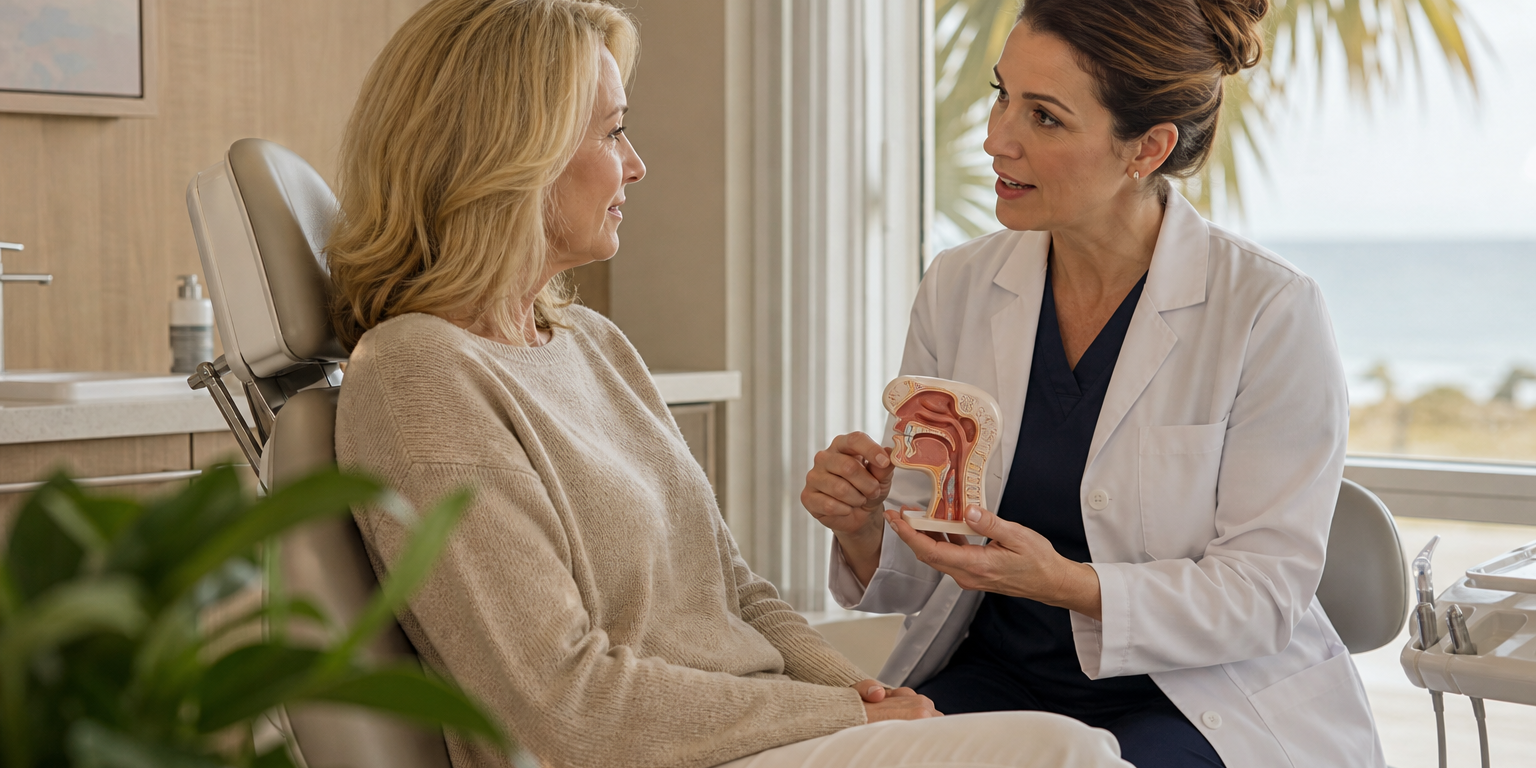
Your first visit is primarily a conversation and an examination. We’re listening for patterns: how you sleep, how you breathe, whether you’ve been told you snore, what your energy is like, and what your jaw and facial structure look like.
We may take photographs or digital scans to evaluate your airway dimensions and bite alignment. If we think a sleep study is warranted, we’ll coordinate with the appropriate specialists. Airway dentistry works best as a collaborative effort, and we don’t hesitate to refer or co-manage with sleep physicians, ENT specialists, or myofunctional therapists when that serves the patient.
Treatment timelines vary. An oral appliance can often be fitted within a few appointments. Palatal expansion is a longer process measured in months. Myofunctional therapy typically runs eight to twelve weeks of consistent practice. We’ll give you an honest picture of what your situation calls for and what to expect at each step.
Frequently Asked Questions
Is airway dentistry the same as sleep apnea treatment?
Airway dentistry overlaps with sleep apnea treatment but covers more ground. Sleep apnea is one condition that airway dentists treat, but the field also addresses snoring without apnea, mouth breathing, tongue tie, restricted jaw development, and the downstream effects of poor breathing on posture, sleep quality, and whole-body health. Not every airway patient has a diagnosable sleep disorder.
Can a dentist actually treat sleep apnea, or do I need a sleep doctor?
Dentists who are trained in dental sleep medicine can provide oral appliance therapy, which is an approved treatment for mild to moderate obstructive sleep apnea. A formal sleep apnea diagnosis typically requires a sleep study ordered or interpreted by a physician. At Wilmington Holistic Dentistry, we work collaboratively with sleep medicine providers rather than treating in isolation, because the best outcomes usually come from that kind of coordinated care.
How is an oral appliance different from a CPAP machine?
A CPAP (Continuous Positive Airway Pressure) machine keeps the airway open by blowing a continuous stream of pressurized air through a mask worn over the nose or mouth. An oral appliance is a small custom-fitted device worn inside the mouth that repositions the lower jaw forward to prevent airway collapse. Oral appliances are quieter, easier to travel with, and more comfortable for many patients, though CPAP remains the gold-standard treatment for severe sleep apnea.
At what age should children be evaluated for airway issues?
Early evaluation is valuable, ideally by age six or seven when the jaw is still developing and intervention has the most impact. Signs in children that warrant an airway assessment include mouth breathing, crowded or crooked teeth, restless sleep, snoring, bedwetting beyond typical age, or behavioral and attention challenges. Earlier treatment tends to produce faster and more stable results because the palate and jaw are more adaptable during growth.
Will my insurance cover airway dentistry or oral appliance therapy?
Coverage varies significantly by plan. Oral appliance therapy for diagnosed sleep apnea is covered by many medical insurance plans (including Medicare in some cases), since it’s treating a medical condition rather than a dental one. A formal sleep apnea diagnosis is usually required for medical billing. We recommend contacting your insurance provider directly and can help with documentation. We’re glad to walk through the specifics with you at your appointment.
Does airway dentistry involve surgery?
Most airway dentistry does not involve surgery. Oral appliances, palatal expanders, and myofunctional therapy are all non-surgical. A frenectomy (tongue tie release) is a minor procedure, but it’s typically done with a laser and involves minimal discomfort and recovery time. Surgical airway interventions, such as jaw advancement surgery, exist for complex cases but are typically considered after conservative options have been explored.
Ready to find out if your breathing is affecting your sleep and your health?
An airway evaluation at Wilmington Holistic Dentistry is a good starting point if any of the patterns here sound familiar. We take the time to look at the full picture, not just the obvious symptoms, and we’ll give you honest information about what your options are. Schedule a consultation or call us at (910) 777-4020.